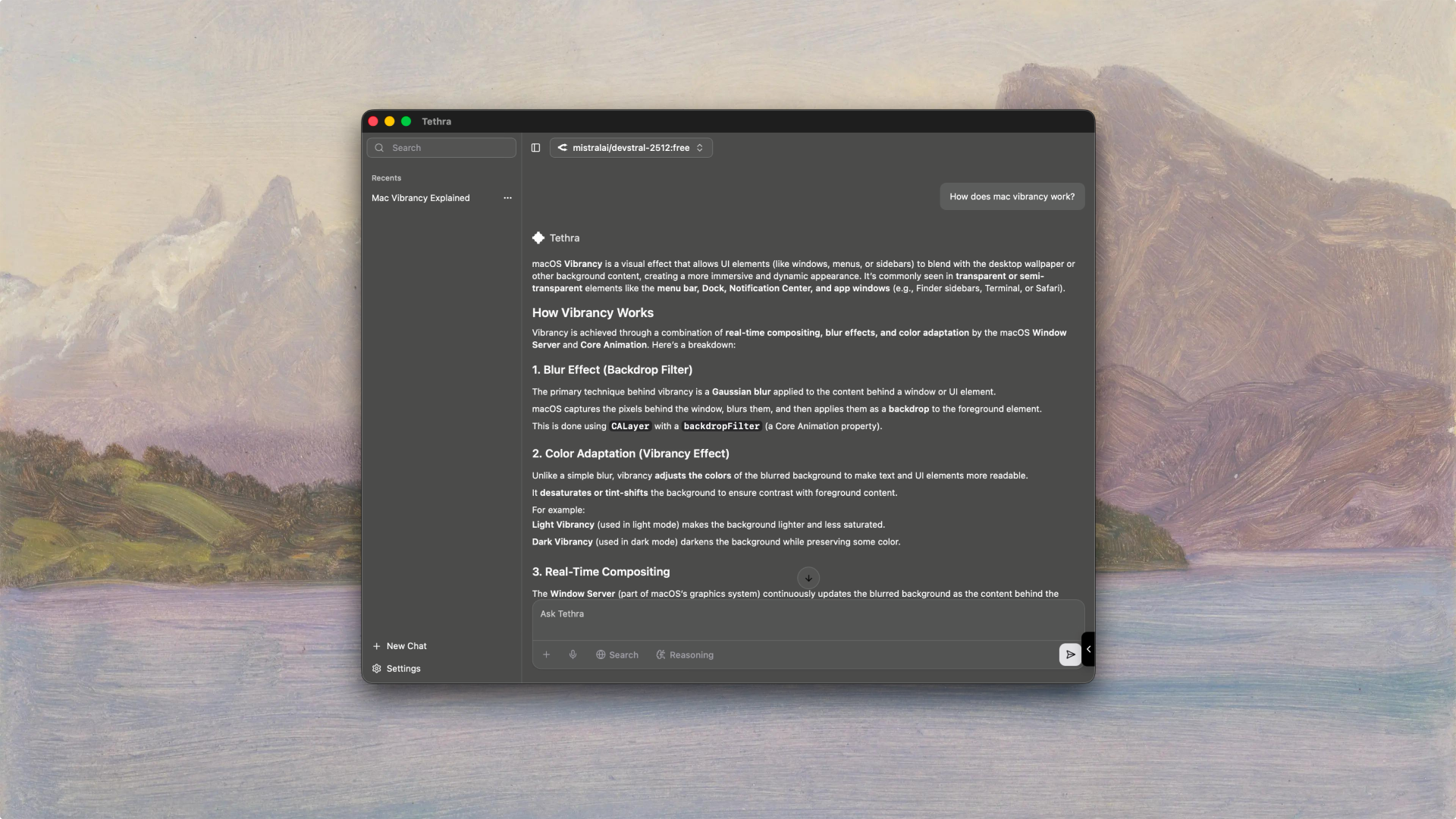
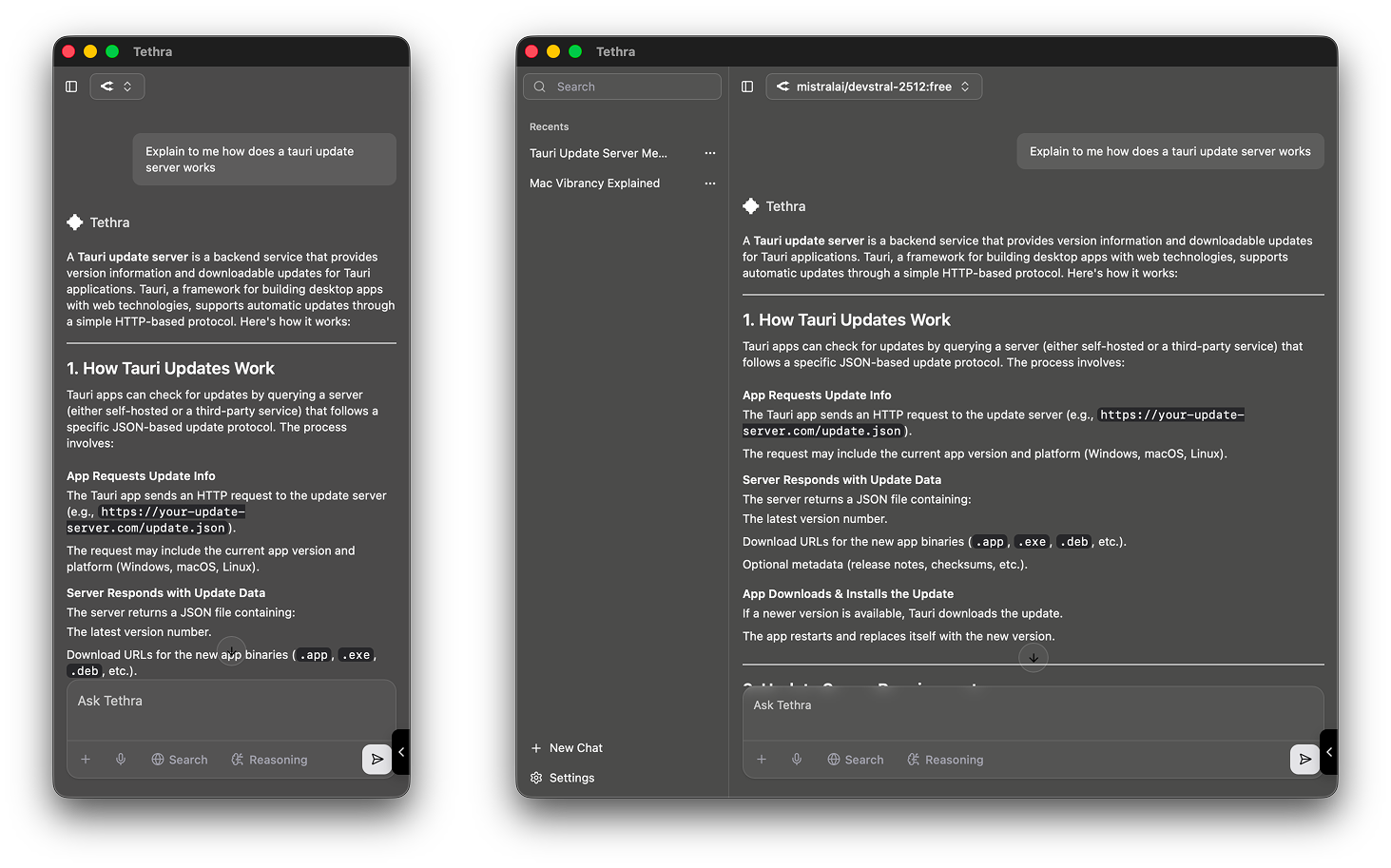
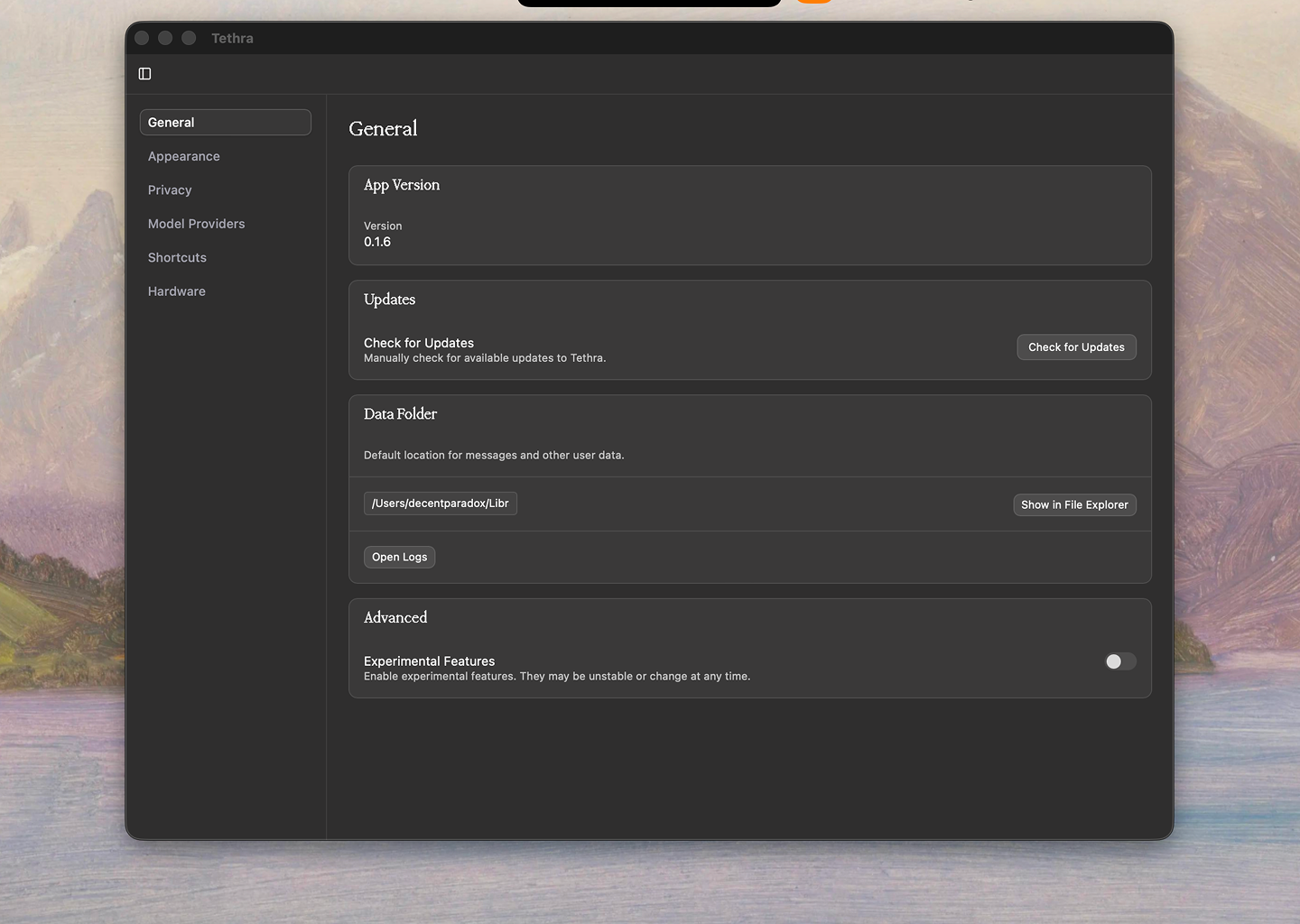
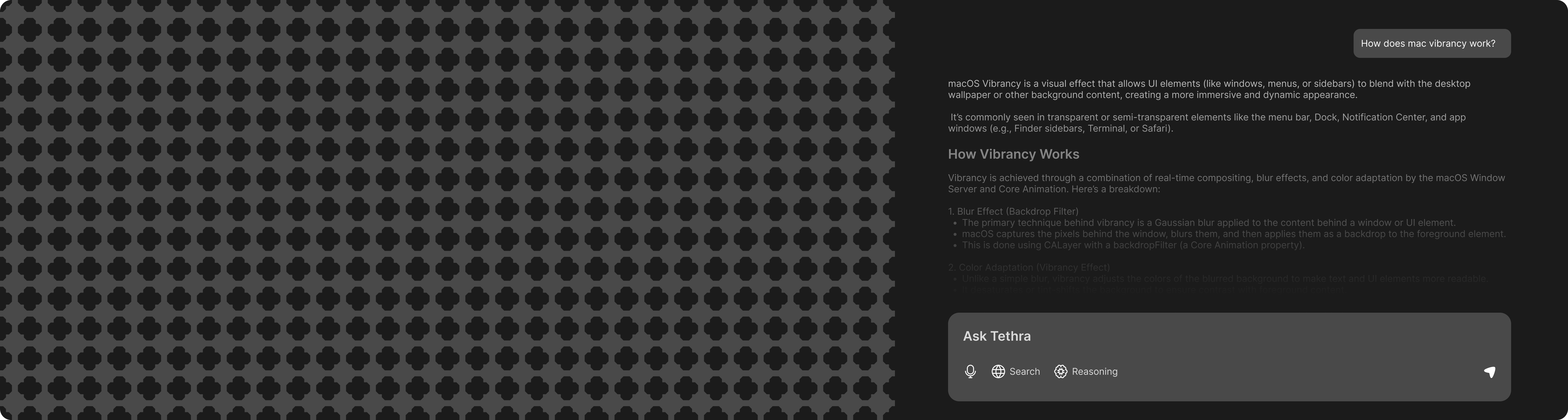
The problem with how we use AI today:
I was doing a lot of AI-assisted work across research, coding, and writing.
Every provider has something different to offer — GPT-4o is solid for
coding, Claude is great for writing, Gemini handles long contexts well.
But switching between them means losing history, losing context, and
constantly re-explaining where you left off. Web interfaces also mean
your conversations are stored on someone else's server by default,
which I wasn't thrilled about.
I picked Tauri over Electron because I didn't want to ship a 200MB
app. Tauri uses the system's native webview and a Rust backend, which
brings the binary down to something reasonable. The tradeoff is that
you're writing some Rust, which has a steeper learning curve, but
for the core functionality — file system access, SQLite, IPC — it
wasn't too bad.
React 19 with TypeScript handles the entire frontend. I used TanStack
Router for file-based routing because it felt more natural than
React Router for this kind of app, and the type safety on params and
search is genuinely good. Shadcn/ui gave me a set of accessible
components to build from rather than starting completely from scratch.
Getting multiple providers to work consistently
Every AI provider has a slightly different API. Some stream differently,
some have different auth schemes, some support function calling differently.
The Vercel AI SDK was a lifesaver here — it abstracts away a lot of
that inconsistency and gives you a unified streaming interface. I was
initially skeptical about adding another dependency for this, but it
genuinely saved a lot of time and the library is well maintained.
Conversations are stored in SQLite via Tauri's SQL plugin. Each conversation
has an ID, the messages stored as JSON, metadata like model and provider,
and a flag for whether it's been published to the web. This local-first
approach means everything works offline and the user owns their data
completely. I didn't want to run any kind of sync service, so the
simplicity of just writing to a local file felt right.
The web sharing part
This was the most interesting problem to solve. Local conversations
are great, but sometimes you want to send someone a link to a useful
exchange you had with an AI. The approach I went with: when you
choose to share a conversation, it gets uploaded to a lightweight
backend that serves it as a static read-only page. The conversation
stays in your local SQLite database — the shared version is just
a snapshot that can be revoked.
The public share page is intentionally simple — just the conversation
rendered cleanly with markdown support. No login required to view it,
and the URL is opaque enough that it won't be guessed. Not a perfect
privacy model, but for casual sharing it works well and doesn't require
the recipient to have an account anywhere.
Reflection:
Tethra pushed me into parts of the stack I hadn't worked with much
before — Rust, SQLite at the application level, and the details of
how streaming AI APIs actually work under the hood. It also made me
think a lot about data ownership and what "local-first" actually
means in practice when you're building for normal users.
Tauri is worth the Rust tax:
The smaller binary size and memory footprint compared to Electron
are real. Writing some Rust for the backend commands took time
to get comfortable with, but the IPC model is clean and the
compiler catches a lot of issues before they become runtime bugs.
I'd reach for Tauri again for any desktop project where
performance and binary size matter.
Abstraction layers save real time:
Using the Vercel AI SDK instead of integrating each provider
directly meant I wasn't reinventing the wheel for every API
difference. The tradeoff is less control over edge cases, but
for most use cases the abstraction is the right call.
Good abstractions exist for a reason — use them.
Local-first is a design commitment, not just a technical one:
Once you commit to local-first, every feature decision flows
from that. The web sharing feature needed careful thought about
what it means to "publish" something from a local database —
the snapshot model turned out to be the right answer.
The architecture of your app shapes what you can and can't
build later — choose it deliberately.